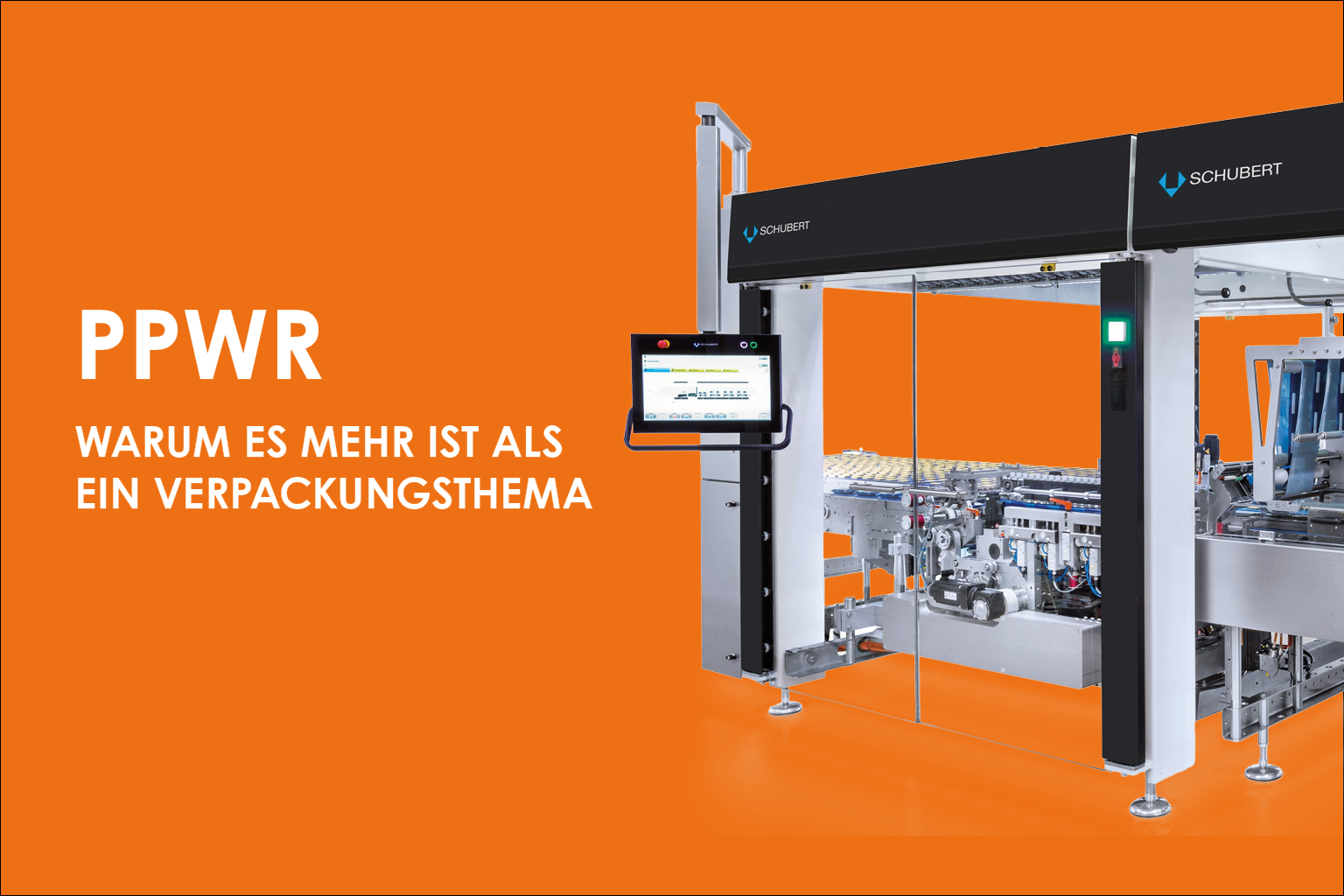
Starting in 2025, one of the EU’s most comprehensive sustainability reforms will come into effect: the Packaging and Packaging Waste Regulation (PPWR).
Its goal is clear – less packaging waste, more reuse, and improved recyclability.
But the impact goes far beyond packaging manufacturers.
Machine builders, automation companies, and industrial equipment manufacturers will also have to demonstrate that their systems enable recycling-oriented design and resource-efficient processes.
The new regulation therefore affects not only the products, but also the production systems that manufacture, fill, or package them.
1. From directive to regulation – a paradigm shift
The previous EU Packaging Directive (94/62/EC) was implemented differently by the member states.
With the PPWR, the EU is now taking a different approach:
It is no longer a directive, but a regulation. It applies directly in all member states, without any national leeway.
For companies, this means:
- uniform rules in all EU countries,
- higher requirements for verification and documentation,
- no transition periods for national implementation.
The goal: a circular economy at the European level. Binding, measurable, controllable.
2. What the PPWR is calling for specifically
The new regulation defines a number of obligations that directly or indirectly affect mechanical engineering.
Here is an overview of the most important points:
a) Design for recycling
Packaging must be designed so that at least 70% of it is recyclable.
For mechanical engineers, this means:
Greater focus on material selection, separability, and processing properties—especially for plastic, composite, or paper packaging.
Machines that form, fill, or seal packaging must support the use of recyclable materials in the future.
b) Reuse and refill
Reusable packaging systems are required by law.
By 2030, certain types of packaging (e.g., transport packaging, beverage packaging) must be reusable to a specified extent.
For machine manufacturers, this results in new requirements for:
- Filling and cleaning systems for reusable packaging,
- Modular systems for changing types of packaging,
- Automated return systems in logistics.
c) Reduction of packaging volume
The PPWR limits the ratio of packaging volume to product.
This means that packaging must become more efficient, lighter, and more compact—without losing protection or functionality.
This also applies to packaging machines, which must respond to smaller formats, material savings, and new geometries.
d) Digital product passports
Another key element is the digital product passport, which is to become mandatory for all packaging from 2030.
It documents material composition, recyclability, and origin.
For machine manufacturers with integrated HMI or traceability systems, this creates an interface between production, data management, and sustainability certification.
3. Impact on medium-sized mechanical engineering companies
Many companies in the German mechanical engineering sector supply equipment to packaging, food, and consumer goods manufacturers—and are therefore directly part of the supply chain covered by the PPWR.
The key challenges:
- Material and process adaptation: In the future, machines will have to be able to process a wider variety of materials—from monomaterial films to bio-based alternatives.
- Retrofittability and flexibility: Systems that are designed for only one packaging system will become less viable in the future. Modular concepts are in demand.
- Data integration: The collection of material data, energy consumption, and carbon footprint is becoming more important—both for compliance and for customer marketing.
- Certification costs: Documentation requirements are increasing. In the future, companies will have to document that their systems can produce in compliance with PPWR.
Those who invest now can gain a real competitive advantage—not only to avoid regulatory risks, but also to position sustainable innovations in a targeted manner.
4. Opportunities through design and innovation
The PPWR is forcing companies to rethink products and processes, thereby opening up space for innovation.
Here are a few examples:
- Reduction through design: Where function, ergonomics, and protection are intelligently combined, packaging material can be reduced without losing product value.
- Modularity instead of single-use technology: Machines that can be converted for different packaging sizes or materials remain economical for longer.
- Suitable materials: The visual and haptic design of packaging will also become a sign of sustainability in the future. In mechanical engineering, design can bridge the gap between technology, brand, and ecology.
- Longevity of equipment: Developing machines for 15–20 years of use automatically creates more sustainability and significantly reduces the ecological footprint per unit produced.
5. Schedule and preparation
Year | Relevant Steps |
2024 | Final legislative process in Brussels; companies should inform themselves and start material/process audits |
2025 | Entry into force of the PPWR (expected in Q2 2025) |
2026–2029 | Transition phase, adaptation of packaging designs, machines, and certifications |
2030 | Mandatory recycling and reuse quotas, obligation to provide a digital product passport |
6. Conclusion: Act now – don't wait
The PPWR is not a distant environmental issue, but a strategic turning point for European mechanical engineering.
Those who react early will secure expertise, innovative advantage, and market opportunities.
Those who wait run the risk of facing enormous pressure to adapt in 2027.
The new PPWR presents mechanical engineers with new design and construction challenges – but at the same time offers enormous opportunities to make processes more efficient and sustainable.
In our work as a design agency for industry, we see how design helps to translate technical and regulatory requirements into marketable innovations at an early stage.
Those who approach this transformation strategically are not only designing products, but also shaping the future.
Sources:
Vorschlag für eine Verordnung über Verpackungen und Verpackungsabfälle (Packaging and Packaging Waste Regulation – PPWR), COM(2022) 677 final.
https://environment.ec.europa.eu/publications/proposal-packaging-and-packaging-waste-regulation_en
Verordnung über Verpackungen und Verpackungsabfälle – PPWR.
https://www.europarl.europa.eu/news/de/headlines/economy/20231123STO15635/ppwr-was-sich-an-den-eu-regeln-fur-verpackungen-andert
Kreislaufwirtschaft und Verpackungsverordnung – Ziele, Anforderungen, Auswirkungen.
https://www.umweltbundesamt.de/themen/abfall-ressourcen/kreislaufwirtschaft/verpackungen
EU-Verpackungsverordnung: Auswirkungen auf den Maschinenbau.
https://www.vdma.org
PPWR: Die neue EU-Verpackungsverordnung und ihre Folgen für Industrie und Handel.
https://verpackung.org
PPWR Explained – A guide for manufacturers and machine builders.
https://packagingeurope.com
EU-Verpackungsverordnung PPWR – Chancen und Herausforderungen für die Kreislaufwirtschaft.
https://www.bde.de